Area Catholic Preparing To Be Notified About Dirt On Forehead All Day Long

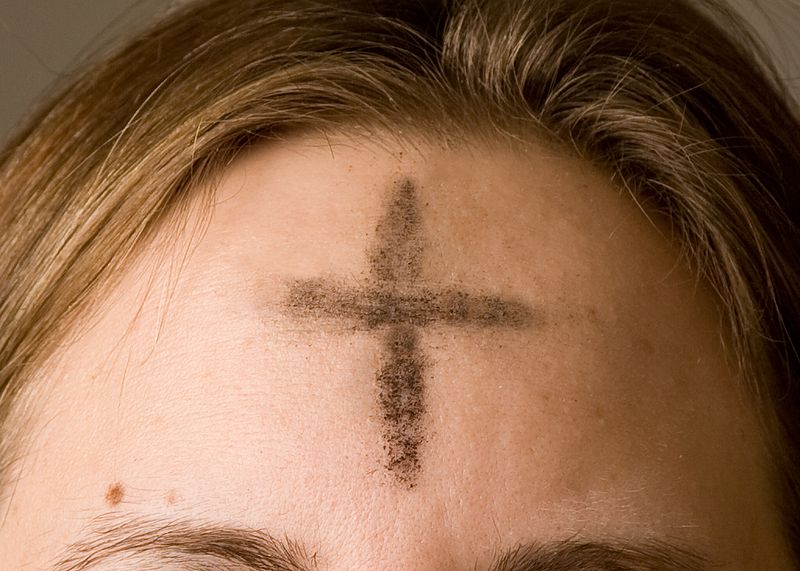
Watertown, MN––While receiving ashes on his forehead at St. Ignatius Catholic Church in Watertown, Minnesota early this morning, area Catholic Trevor Davis fervently prayed for patience to endure what he expected to be a “long day filled with well-intentioned, yet obnoxious remarks” about the dirt on his forehead. “Look, here’s the deal,” he reportedly told St. Monica, the Patron Saint of Patience, as he returned to his pew. “I know it should be an opportunity to evangelize, but come on…we do this every year, and every year people act like it’s the first time they’ve ever seen a Catholic on Ash Wednesday?” Davis later went on to pray, asking his Guardian Angel to protect him from the horde of nominal Catholic friends that didn’t make it to Mass, and that were inevitably bound to ask him if he wouldn’t mind bumping heads just a bit. At press time, a nominal Catholic stranger at the local coffee shop was in the process of informing Davis that he had indeed completely forgotten about Ash Wednesday due to getting “smashed” on Mardi Gras.

5 thoughts on “Area Catholic Preparing To Be Notified About Dirt On Forehead All Day Long

  1. A serious Catholic question for the seriously-Catholic readers of a less-than-serious Catholic website:

    How is wearing ashes on our foreheads to mark the beginning of a season of fasting not in violation of the Gospel message for the same day? “When you fast, do not look gloomy like the hypocrites…” What could be more gloomy than wearing ashes? In fact, it is ~almost~ as if Christ warns against this exact practice: “When you fast… wash your face, so that you may not appear to be fasting.” My forehead is hardly the ideal place for me to remind myself of my fast, but it is the ideal place for making a show of my fast before my neighbors. If a non-Catholic neighbor asks me why I am wearing ashes, and I explain all about Ash Wednesday and Lent, this implies to him – since I am wearing the ashes, which he has clearly noticed – that I too am fasting. But if I allow him to find out that I am fasting, don’t I already have my reward here on earth?

    Please note that this question is not in any way a challenge to the authority of the Church – it is asked by a faithful and obedient Catholic, whose faith seeks understanding. Please, no vitriolic rants or knee-jerk answers: I seek only a well-thought-out answer that understands my confusion and addresses it with an authoritative teaching.

    • That’s a really good question, and something I’ve wrestled with, too. I’m hoping someone else will chime in here, as well, but here’s what I was told when I asked the question of a Catholic who’s far beyond me in knowledge/spirituality:

      The ashes are not a symbol of fasting (to exemplify that, note that even little kids, old people, and pregnant women get ashes, even though they’re completely exempt from the fasting and abstinence regs). They’re a sacramental to remind us that we are sinners. Just like the people who sat down in the ashes and rent their clothes to show their repentance (because we’re a physical people – body and soul – and need our symbols), the ashes on our foreheads are a small way to remind us that we need to turn ourselves back to Christ, who raises us from the dust to which we shall return.

    • Hello! It’s a good question, but the ashes have nothing to do with fasting.

      The ashes are there to remind us that we are dust, and that to dust we will return. Thus, we need to “repent and believe in the Gospel.”

      God bless!

    • An answer I gave to myself is that to do what all the rest of the church is doing does not “singularize” yourself [IN ORDER to be seen]; it shows we are as a corporate body [ ??(] doing a faith action in unity. That action is in obedience to Christ. The fasting and prayer that are done in secret are those that express your personal union with God; if done publicly it is merely to appear singular and of exalted holiness.